Brand marketing vs performance marketing: what is the difference, and how should you split the budget?
Brand marketing makes more people know and prefer you before they are ready to buy; performance marketing turns people who are ready into customers now. The two work on different timelines and need different metrics. Here is how they compare, what the evidence says about splitting the budget, and simple rules for small and growing businesses.
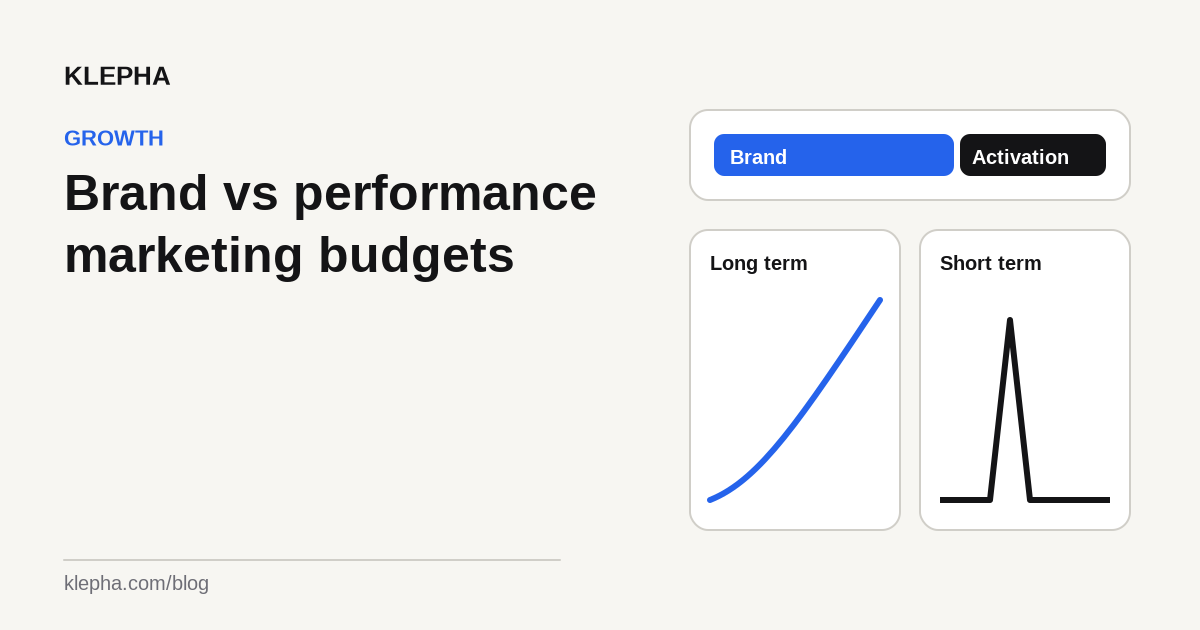
Brand marketing aims to build memory and preference among people who are not buying yet, so its effects grow slowly and last; performance marketing (also called sales activation) aims to get people who are already in the market to act now, so its effects are fast, measurable and short lived. Most businesses need both, because performance marketing harvests demand that brand marketing helps create.
The most cited benchmark comes from the IPA, whose analysis of 40 years of Effectiveness Awards case studies found the best business outcomes came from investing "just over 60 per cent on brand building and a little under 40 per cent on activation." That is an average for established brands, not a rule for a startup. Below we compare the two, then give practical split ranges by stage.
Key takeaways
- Different jobs: brand builds future demand; performance converts demand that already exists.
- Different clocks: performance pays back in days or weeks; brand effects build over months and years.
- Different metrics: judge brand on reach, recall, branded search and pricing power, not last click ROAS.
- 60:40 is an average: it comes from IPA award cases, mostly established brands, and shifts by category and stage.
- Start lean, shift over time: small businesses often begin activation heavy and move budget to brand as conversion data matures.
What is the difference between brand and performance marketing?
Brand marketing (brand building) is activity designed to make a broad audience notice, remember and feel positively about you, so that when they do need what you sell, you come to mind first. Examples: video and audio campaigns, sponsorships, consistent social content, PR, thought leadership, and memorable creative repeated over time.
Performance marketing (sales activation) is activity designed to trigger an action now from people already in the market. Examples: search ads, shopping ads, retargeting, affiliate deals, promotional emails and conversion focused landing pages. It is usually paid per click or per conversion and measured directly.
The line is not about channels. A YouTube ad with a strong story and no discount is brand marketing; the same channel with "20% off today only" is activation. What matters is the objective and the audience: future buyers or current buyers.
How do goals, timelines and metrics compare?
| Brand marketing | Performance marketing | |
|---|---|---|
| Main goal | Be known, remembered and preferred | Drive a click, lead or sale now |
| Audience | Everyone who might buy in the category, most of whom are not buying today | People already searching or showing intent |
| Timeline | Builds over months and years; effects persist | Results in days or weeks; effects fade quickly when spend stops |
| Typical channels | Video, audio, social reach, PR, sponsorship, content | Search, shopping, retargeting, affiliates, promotional email |
| Core metrics | Reach, aided and unaided awareness, branded search volume, share of search, price premium | CPA, ROAS, conversion rate, cost per lead, payback period |
| Main risk | Hard to attribute, easy to cut | Rising costs and diminishing returns as you exhaust existing demand |
The interaction matters more than the comparison. Brand marketing tends to make performance marketing cheaper: people who already know you click your ads more and convert more often. That is why cutting brand spend can look free for a quarter and expensive a year later.
What does the evidence say about the split?
The best known work is by Les Binet and Peter Field for the IPA (the UK's Institute of Practitioners in Advertising). Their 2013 report The Long and the Short of It examined how campaign effects develop over time and warned that relying on very short term online metrics "has dangerous implications for long-term success." The IPA's current summary of the research, based on 40 years of Effectiveness Awards case studies, concludes that across all contexts the optimum split is "just over 60 per cent on brand building and a little under 40 per cent on activation."
Read that number carefully:
- It is an average across award entries. Those are mostly established brands with meaningful budgets, not early stage startups.
- It is not a target for every business. Because it averages many categories and contexts, the right balance for one company can sit well above or below it. Treat 60:40 as a starting reference for a mature brand, not a law.
- It assumes both parts are done well. A 60% brand budget spent on forgettable creative will not outperform focused activation.
How should a small or growing business split its budget?
Small businesses face a real constraint: cash today matters more than market share in three years. The answer is not to ignore brand, but to start where payback is fastest and shift gradually. These are rules of thumb, not research findings:
| Stage | Starting split (brand : performance) | Why |
|---|---|---|
| Pre product market fit or first months | 10:90 to 20:80 | Validate the offer and learn which messages convert; keep payback short |
| Proven unit economics, growing | 30:70 to 40:60 | Search demand starts to cap out; brand widens the pool of future buyers |
| Established, competitive category | 50:50 to 60:40 | Long term growth depends on more people knowing you, closer to the IPA benchmark |
Five simple rules help regardless of stage:
- Fund the demand you can capture first. Branded and high intent search terms are usually the cheapest conversions you will get.
- Watch for diminishing returns. When extra performance spend raises CPA sharply, you have exhausted current demand; that is the signal to invest in creating more.
- Pick one brand channel and stay consistent. A small budget spread across five channels is invisible. Repetition and distinctive assets matter more than variety.
- Count low cost brand work. Content, PR, community and organic search build brand too. Owned content that answers buyer questions also feeds AI assistants, which increasingly shape what people know about a brand before they search.
- Review quarterly, not weekly. Brand effects will not show in a weekly ROAS report. Set a quarter long test before judging.
To size the performance side properly, start from unit economics: our guides on calculating CAC and LTV and break even ROAS show how much you can afford to pay per customer.
Brand now includes what AI says about you.
Klepha's free report shows how ChatGPT, Gemini and Perplexity describe your brand and which buyer questions your competitors answer and you do not.
Get my free reportA worked example for a small business
Take an online store spending $5,000 a month, almost all of it on search and shopping ads, with a healthy return. Over six months the owner notices that extra spend buys less: raising the budget by $1,000 adds few sales because the people already searching for the products are mostly being reached. That is the signal described above. A reasonable next step is to move $1,000 to $1,500 a month into one consistent brand channel, for example short videos with the same visual style and message every week, plus content that answers buyer questions, and keep it running for at least a quarter. Success is judged on branded search, direct traffic, returning customers and the cost per sale on the remaining performance budget, not on the ROAS of the videos themselves.
The same logic applies to SaaS and B2B. Most of your future customers are not looking for your product this quarter. Brand work is how they hear of you before they start the search, which is when performance marketing can finally reach them.
How do you measure brand marketing?
Brand work fails last click attribution almost by definition, so measure it with metrics built for it:
- Branded search volume and share of search. Track branded impressions in Google Search Console and compare your branded search volume with competitors'. Search Console now separates branded and non branded queries automatically for eligible sites; see our guide to the Search Analytics API branded filter.
- Direct and returning traffic. Rising direct visits and returning users suggest more people remember you.
- Awareness surveys. Even a small quarterly survey asking "which brands come to mind for X" gives a trend.
- Conversion rate and CPA on performance channels. If brand work is helping, these improve at the same spend.
- AI visibility. How often and how accurately AI assistants mention you for category questions is a growing part of brand reach; see how to track AI brand visibility.
- Price premium. Strong brands can hold prices; watch discount depth and win rates.
What mistakes should you avoid?
- Judging brand spend on ROAS. It will always lose that comparison and get cut.
- Calling retargeting "brand". Showing ads to past visitors is activation, however nice the creative.
- Changing the message every month. Brand memory needs consistent, distinctive cues: name, colours, tone, a clear positioning. Our brand positioning statement guide helps define it.
- Forgetting the funnel connects. Brand fills the top; performance captures the bottom. Map both in one marketing funnel.
Organic search and AI visibility sit between the two: they capture existing demand and build reputation at the same time. The disciplines we use for that are on our expertise page, our ChatGPT Ranking solution covers AI visibility, and our case studies show how it works in practice.
Sources
- IPA: Striking the right balance for your brand. Evidence from 40 years of IPA Effectiveness Awards case studies; last updated October 23, 2026; accessed November 23, 2026. Source of the "just over 60 per cent" brand and "a little under 40 per cent" activation finding.
- IPA: The Long and the Short of It: Balancing Short and Long-Term Marketing Strategies, by Les Binet and Peter Field (2013). Publication page accessed November 23, 2026.
- Google Search Central Blog: Introducing the branded queries filter in Search Console. Published November 20, 2025; accessed November 23, 2026.
Frequently asked questions
What is the difference between brand marketing and performance marketing?
Brand marketing builds awareness and preference among people who are not buying yet, so its effects are slow and long lasting. Performance marketing targets people already in the market to drive an action now, so its effects are fast, directly measurable and short lived.
What is the 60:40 rule in marketing?
It is the IPA finding, from Les Binet and Peter Field's analysis of Effectiveness Awards cases, that the best business outcomes on average came from spending just over 60 percent on brand building and a little under 40 percent on sales activation. It is an average for mostly established brands, not a fixed rule.
How much should a small business spend on brand marketing?
There is no single right number. Many small businesses start with most of the budget on performance to validate the offer and protect cash, then move toward 30 to 40 percent brand once unit economics are proven and high intent demand starts to cap out.
How do you measure brand marketing ROI?
Use metrics suited to long term effects: branded search volume, share of search, direct and returning traffic, awareness surveys, price premium, and whether conversion rates and CPA on performance channels improve at the same spend. Review quarterly rather than weekly.
Is SEO brand marketing or performance marketing?
Both. Ranking for high intent searches captures existing demand like performance marketing, while helpful content that people see, remember and that AI assistants cite builds familiarity like brand marketing.