ChatGPT ads in 2026: how they work, who can buy them and whether to test now
OpenAI's ad program went from a small US pilot in February to a self-serve platform in 89 countries by October. Here is what is officially confirmed, what early advertisers are reporting, and how to decide if a test is worth your budget.
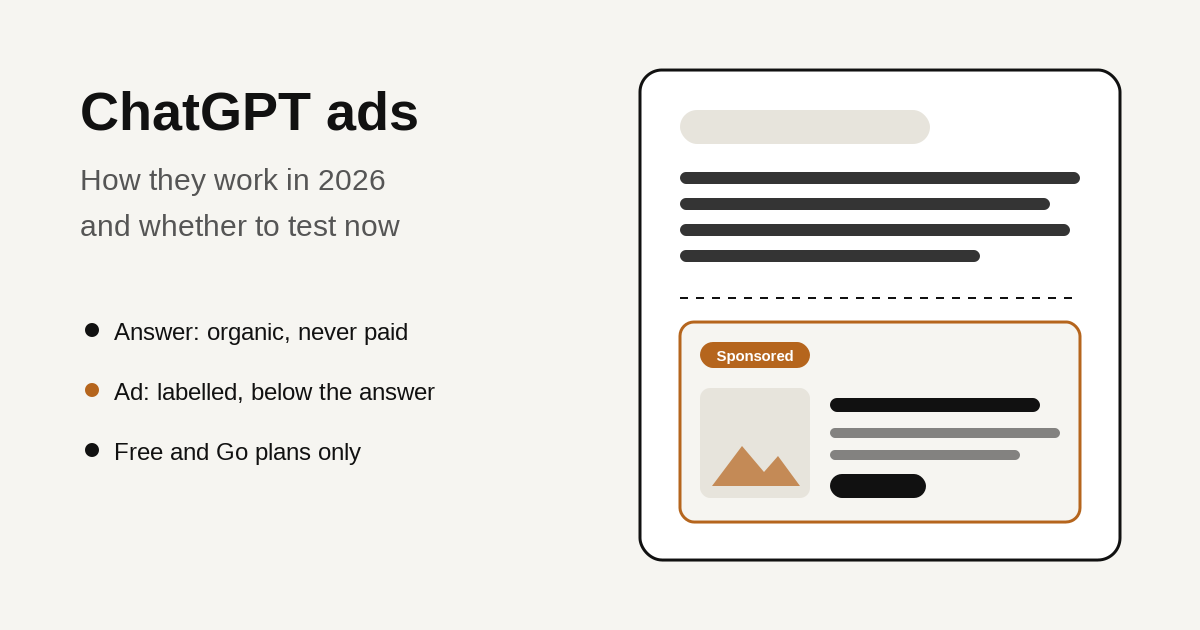
ChatGPT ads are clearly labelled sponsored units that OpenAI shows below ChatGPT's answers to logged-in adult users on the Free and Go plans, and they do not change what the answer says. Any business whose billing entity is based in a supported country can now buy them through OpenAI's self-serve Ads Manager beta from a minimum of 25 USD a day, bidding on impressions, clicks or conversions.
That is the short version as of November 8, 2026, updated on November 15, 2026 with OpenAI's change from maximum bids to average cost targets. The longer version matters because the program has changed almost every month since launch, the evidence on performance is thin and mixed, and many marketers still confuse paid placement with the organic citations that most of ChatGPT's commercial influence actually runs through.
Key takeaways
- Officially live in 89 countries as of OpenAI's October 21, 2026 update, with more than 100,000 advertisers having run campaigns.
- Only Free and Go users see ads. Plus, Pro, Business, Enterprise and Edu accounts are ad free, and so are accounts identified as under 18.
- Self-serve is open through Ads Manager beta, with CPM, CPC and conversion-optimized buying and a 25 USD (15 EUR, 15 GBP) minimum daily budget.
- OpenAI publishes no performance benchmarks. Its own partner case studies are positive; independent studies so far show lower conversion rates than Google Search.
- Max Bid and Max CPC are being retired. New campaigns use average Target CPA or Target CPC from November 9, 2026, and the old caps stop applying to existing campaigns on January 1, 2027.
- Ads do not buy citations. Being named inside the answer still depends on organic visibility, which you cannot purchase.
What are ChatGPT ads, and when did they launch?
OpenAI began testing ads in the United States on February 9, 2026, for logged-in adults on the Free and Go tiers. It described the purpose as funding broader free and low-cost access, and published a set of principles alongside the launch: answer independence, conversation privacy, user choice and control, and not optimizing for time spent.
The rollout since then has been fast. Every date below comes from OpenAI's own announcements or its Help Center.
| Date (2026) | What OpenAI announced |
|---|---|
| February 9 | Ads test begins in the US for logged-in adult Free and Go users. |
| March 26 | OpenAI reports no impact on consumer trust metrics and low dismissal rates; pilots announced for Canada, Australia and New Zealand. |
| May 5 | Beta self-serve Ads Manager, buying through agency and technology partners, CPC bidding added to CPM, plus Conversions API and pixel measurement. |
| August 11 | Ads launched in the UK, Mexico, Brazil, Japan and South Korea. |
| August 18 and 31 | Expansion to 31 European markets, first through OpenAI's sales team and partners, then self-serve from August 31. |
| September 23 | Expansion to Southeast Asia and Taiwan. |
| October 5 | A multi-image visual ad format announced for testing during image generation, plus new measurement and brand suitability partners. |
| October 21 | 26 more countries, bringing availability to 89; over 100,000 advertisers have run campaigns. |
OpenAI's advertiser FAQ still calls the product a beta "in the early stages of scaling", with a focused pilot from February through April before self-serve onboarding began. Expect delivery, formats and buying options to keep shifting.
Who sees ads in ChatGPT, and where do they appear?
According to OpenAI's Help Center article on ads in ChatGPT, ads may appear for users on the Free and Go plans. Plus, Pro, Business, Enterprise and Edu accounts do not get ads. OpenAI does not show ads to accounts identified as belonging to people under 18, using stated age and an age prediction model. Ads shown in logged-out experiences must be suitable for all audiences.
Free users can also switch to an ads-free mode in exchange for lower message limits and fewer tools, such as image generation and deep research. Temporary Chats never show ads.
Formats
The standard unit sits below a ChatGPT response. Users see one ad unit at a time, which can contain one or more images. Each ad carries the advertiser name, a favicon, a headline, description copy, an image and a landing page. The Help Center also refers to product-feed campaigns, including a Shopify connection, for retailers that want catalog items shown with images and prices.
The newest format is a multi-image visual ad shown while ChatGPT generates an image. OpenAI said on October 5, 2026 that testing would begin later that month in the US with an initial group of advertisers. The ad is labelled, sits apart from the image being created, and disappears once the image finishes.
Where ads never appear
OpenAI states that ads are not eligible to appear near sensitive topics, including personal health, mental health and politics, and that it currently does not allow political advertising. Advertisers in regulated categories such as health and financial services may qualify under stricter eligibility rules, but still will not be placed next to sensitive personal conversations.
How are ads kept separate from ChatGPT's answers?
OpenAI's position, repeated in every announcement, is that ads do not influence answers. Its Help Center says ads run on separate systems from the chat model and that advertisers "have no ability to shape, rank, or alter ChatGPT's responses." Ads are labelled as sponsored and visually separated from the response.
Ad selection uses its own signals: the context and intent of the current conversation, the ad's landing page, title and copy, advertiser-provided context hints and targeting, and, when a user has ads personalization switched on, signals from past chats, memory and ad interactions. When several ads qualify, relevance and bids together decide which is shown.
Privacy rules advertisers should know
- Advertisers never receive chats, chat history, memories, names, email addresses, precise location or IP addresses.
- Reporting is aggregated: views, clicks and conversions, not individual prompts. You cannot see which conversation triggered your ad.
- Users can turn off personalization, view why an ad appeared, hide or report it, and delete ads data, which is removed within 30 days.
- Personalized ads are not initially available in the EEA or Switzerland, so European campaigns rely on the current conversation context.
For marketers, the practical consequence is that you buy context, not keywords. You describe where your product is relevant, and OpenAI's system decides which conversations match.
Who can buy ChatGPT ads today?
There are two routes, and which one fits depends on your size and country.
Self-serve through Ads Manager beta. Businesses sign up at ads.openai.com, add payment details, set budgets and bids, upload ads and launch campaigns. OpenAI's availability page states that the legal entity being billed must be based in a listed country. On November 8, 2026 that list covered the US, Canada, the UK, all 27 EU countries, Switzerland, Norway, Japan, Korea, India, Australia, New Zealand, much of Latin America and several markets across Southeast Asia, the Middle East and Africa. Creating an account in an unsupported country does not grant early access.
Managed or partner buying. OpenAI works with agency groups including Dentsu, Omnicom, Publicis and WPP, and technology partners including Adobe, Criteo, Kargo, Pacvue and StackAdapt. Larger advertisers with complex needs can contact OpenAI's Ads team directly.
Minimum budgets and account limits
| Billing currency | Minimum daily budget |
|---|---|
| USD | 25 USD |
| EUR | 15 EUR |
| GBP | 15 GBP |
| CAD / AUD / NZD | 25 in local currency |
| JPY | 2,500 JPY |
| INR | 725 INR |
Two details catch new accounts out. First, a daily budget is an average over a Sunday to Saturday week, so a single day can spend up to twice the amount. Second, some new self-serve accounts can only advertise in their home country until identity verification is approved and they reach a required spend level there. If you plan a multi-country test, budget time for that.
Unofficial reports of high pilot minimums and CPMs circulated online early in the year. OpenAI never published those figures, and they do not describe today's self-serve access.
How does ChatGPT ads pricing and bidding work?
OpenAI does not publish a rate card. Prices are set in an auction, where the winning bid determines what you pay. You pick one of three campaign objectives.
| Objective | You are billed for | Best suited to |
|---|---|---|
| Views (CPM) | Each 1,000 impressions | Awareness and launches |
| Clicks (CPC) | Each valid click | Driving site traffic |
| Conversions | Valid clicks (oCPC) or impressions (oCPM), never per conversion | Purchases, leads, sign-ups with tracking installed |
OpenAI's bidding page says "the final winning auction bid sets the price you pay", and that this rule applies across all bidding strategies. Its basics page still recommends starting click campaigns with a maximum bid of 3 to 5 USD per click when we checked on November 15, 2026, but that advice describes the legacy Max CPC control that is now being retired, covered below.
How is ChatGPT Ads bidding changing from Max Bid to cost targets?
OpenAI is replacing two manual caps, Max Bid and Max CPC, with average cost targets. Its Help Center article on bidding strategies, updated in early November 2026 and checked on November 15, sets out three options: Intelligent bidding (the new name for Maximize Results, or Autobid), Target CPA for conversion campaigns and Target CPC for click campaigns. The difference matters: a maximum caps every individual bid, while a target is an average the system works toward, bidding above or below it in individual auctions.
| Date | New campaigns | Existing campaigns | API partners |
|---|---|---|---|
| November 9, 2026 | Target CPA replaces Max Bid for conversion campaigns; Target CPC available for click campaigns | Can start moving to the new options in Ads Manager | Max Bid and Max CPC fields keep their old behavior |
| November 18, 2026 | No change | No change | New Target CPA and Target CPC fields recommended. Legacy fields used to create a campaign or change an ad group's bid type now select Target CPA or Target CPC, and the value counts as an average target, not a maximum |
| December 31, 2026 | No change | Last day Max Bid and Max CPC apply | Last day legacy fields are supported |
| January 1, 2027 | Targets only | Max Bid and Max CPC retired | Legacy fields deprecated |
What changes for advertisers
- No hard ceiling per click or conversion. OpenAI states that a target "is not a fixed price per conversion or click" and that actual average costs can be higher or lower than the target.
- Targets set too low limit delivery. OpenAI's worked example: 400 USD spend and 10 purchases is a 40 USD actual CPA, and setting a 20 USD target does not mean the system can deliver purchases at half that cost. Campaigns may also underspend when targets are too restrictive or conversion signals are weak.
- Bidding goal and billing are separate. A Target CPA campaign can still be billed per click or per impression, depending on its billing setting.
- Audience multipliers stack on the target. OpenAI's example: a 50 USD Target CPA with a 1.2x new-customer multiplier gives that segment a 60 USD target.
- Unanswered question: OpenAI's bidding page does not say what target a campaign still on Max Bid or Max CPC will get after January 1, 2027, as Search Engine Journal noted on November 10. Switching yourself lets you choose it.
How should advertisers adjust?
- Pull recent actuals. Use a consistent reporting period for the same conversion event and allow for reporting delay, as OpenAI recommends.
- Set the first target at or near actual cost, then move it gradually toward what a customer is worth to you. Our guide to calculating CAC and LTV shows how to find that ceiling.
- Fix conversion data before switching conversion campaigns. Check that real events reach the pixel or Conversions API and review the Event Quality Score; see conversion tracking before you spend on ads.
- Move existing campaigns before January 1, 2027, so you choose the target rather than leaving it to the platform.
- Ask your tools what they send. If you buy through an agency platform or API partner, confirm which bid fields it uses after November 18, because an old maximum value may now be read as an average target.
- Watch actual average cost weekly alongside spend and results while the campaign learns, and expect individual clicks above your target.
The same move away from hard caps has already happened elsewhere: Search Engine Journal reported in August 2026 that Microsoft Advertising would stop offering Max CPC on new non-portfolio campaigns using Target CPA or Target ROAS from October 1.
What targeting and measurement do advertisers get?
Targeting is deliberately broad compared with search or social. OpenAI has said it builds guardrails "to prevent narrow ads targeting". The levers available in Ads Manager are:
- Context hints at the ad group level, describing topics or conversations where you are relevant. OpenAI is explicit that these are not exact-match keywords and do not guarantee delivery.
- Location by country, and for most campaign types by region, city or postal code.
- Platform: Android app, Android web, desktop web, iOS app and iOS web.
- Custom audiences to include or exclude. Inclusion needs at least 25,000 matched users, and OpenAI advises against custom audiences in the EEA and Switzerland.
- Negative Phrases for brand-specific placement exclusions, available to qualifying advertisers only.
Reporting covers impressions, clicks, spend, CTR, average CPC, average CPM and conversions. Conversions come from the OpenAI pixel or Conversions API, with integrations through partners such as AppsFlyer, Triple Whale, Northbeam, Hightouch, Tealium and LiveRamp. UTM parameters persist on clicks, so you can also judge ChatGPT traffic in your own analytics, which we recommend regardless.
See where ChatGPT already mentions you, for free
Before paying for placement, check how ChatGPT, Gemini and Perplexity answer your category's real questions today, and who they name instead of you.
Run my free reportWhat are early ChatGPT advertisers learning?
OpenAI's advertiser FAQ says plainly that the platform "does not yet have performance benchmarks across advertisers, industries, or campaign types." What exists is a mix of vendor-supplied case studies and a few independent analyses. They point in different directions, so the source matters as much as the number.
| Finding | Source and date | Type |
|---|---|---|
| WeightWatchers' attributed CPA was 15.3% lower than its blended paid search benchmark | DV Rockerbox, quoted by OpenAI, Oct 5, 2026 | Partner case study |
| 67% of incremental purchases for wellness brand Dose came from new customers | WorkMagic, quoted by OpenAI, Oct 5, 2026 | Partner case study |
| 93% of Portland Leather's visitors from ChatGPT ads were new | Triple Whale, quoted by OpenAI, Oct 5, 2026 | Partner case study |
| 43% of ad-eligible US users had seen an ad after six months; CTR roughly doubled since launch; top advertisers wrote 98% new copy for ChatGPT | Graphite and Similarweb, via Search Engine Land, Sep 29, 2026 | Third-party analysis |
| Paid ChatGPT visits earned 0.89 USD per session versus 2.45 USD for Google Search ads; conversion rate 0.37% versus 1.17% | WU Vienna and Frankfurt School working paper, via Search Engine Land, Nov 2, 2026 | Academic, observational |
| B2B client: CPC 0.76 USD versus 10.46 USD on Google, cost per lead 92.21 USD versus 157.57 USD, but conversion rate 0.8% versus 6.64% and weaker lead quality | StubGroup agency case study, updated Oct 28, 2026 | Single-account anecdote |
Read together, a consistent pattern emerges. ChatGPT ads reach many people who are new to a brand, which is what the partner case studies emphasize. Clicks tend to be cheaper than on Google Search, but visitors convert less often and are worth less per session, which is what the independent work emphasizes. Whether the channel pays off depends on whether the cheaper click outweighs the weaker conversion for your product.
The Graphite analysis also found that ads in the first few turns of a conversation earned the strongest CTR and impression share, and that leading advertisers write copy for ChatGPT rather than recycling search or social ads. Graphite, like most practitioners, advised treating ChatGPT as an experimental budget, not a replacement for search spend. Our ChatGPT ads vs Google Ads comparison shows how to size and judge that test budget.
One finding deserves attention from anyone who relies on organic AI traffic. The same working paper estimated that unpaid ChatGPT referrals fell by 5.9% in the first 13 weeks after ads launched, a result that was not statistically significant, rising to 7.2% to 8.4% under further assumptions. It is a single observational study, but it is the first evidence that ads and organic referrals may compete for the same clicks. Since November 10, 2026, verified businesses can also see recorded ChatGPT website clicks in OpenAI's ChatGPT Business Hub, which gives a first-party baseline for organic referrals.
How are paid ChatGPT ads different from organic citations?
This is the distinction most briefs get wrong. A ChatGPT ad is a separate, labelled unit below the answer. An organic citation is your brand or page being named or linked inside the answer itself. OpenAI states that advertisers cannot shape, rank or alter responses, so no ad budget buys a mention in the answer. Product results in ChatGPT shopping are organic too, and our guide to ChatGPT shopping for merchants explains how stores get into them.
| Paid ChatGPT ad | Organic citation | |
|---|---|---|
| Where it shows | Below the answer, labelled sponsored | Inside the answer text or its source links |
| Who sees it | Free and Go users in supported countries | Every user, on every plan |
| How you get it | Auction bid, budget and creative | Crawlable, citable content and third-party corroboration |
| Cost model | Per impression or click | Content and outreach work; no per-click fee |
| Stops when | Budget is paused | Sources change or competitors overtake you |
The two work best together. Ads give you guaranteed placement with measurable clicks on part of the audience. Citations reach every plan, including the paying Plus, Pro and Business users who never see ads, and they carry the implied endorsement of the answer itself. Our guide on how to appear in ChatGPT answers explains the retrieval and selection stages behind citations, and our ChatGPT Ranking service covers that work for brands that want it done for them.
Should you test ChatGPT ads now?
For most businesses with an existing paid search program and conversion tracking, a small, structured test is reasonable. The minimum spend is low, competition is still forming, and the creative lessons transfer to whatever formats come next. It is not reasonable to move core search budget into the channel on today's evidence. Before setting bids, work out your maximum cost per customer with our guide to calculating CAC and LTV.
By business type
- Ecommerce: the strongest case. Product-feed campaigns, Shopify integration and conversion optimization exist, and the published partner results come mostly from consumer brands. Watch revenue per session, not just ROAS from the platform.
- SaaS and B2B: test with a narrow product or use case and measure down-funnel quality. The StubGroup case shows cheap leads that closed less often than Google leads.
- Agencies: run controlled tests for clients where new-customer reach matters, and set expectations that there are no official benchmarks and that reporting excludes prompts.
- Founders and early startups: fix organic AI visibility first if ChatGPT rarely names you. A 25 USD a day test can teach you which conversations you belong in, but it will not make the answer mention you.
- Regulated, political or health-focused brands: expect strict eligibility rules or no eligibility at all, and check OpenAI's ad policies first.
A simple four-week test plan
- Check eligibility. Confirm your billing entity's country on the availability page and whether your account is limited to its home country.
- Install measurement first. Set up the pixel or Conversions API, add UTM parameters, and agree a baseline from your Google Search data.
- Start with clicks or conversions. Use two or three ad groups with distinct context hints and copy written for conversations, not keywords. Point them at existing high-intent pages.
- Judge on business outcomes. After four weeks, compare cost per qualified lead or revenue per session with search, and check whether organic ChatGPT referrals moved.
If you want a broader view of where paid and organic AI search sit in your plan, our team shares how we approach it on the expertise page, with results from past work on case studies. For the organic side specifically, see why ChatGPT may not be mentioning your brand.
Sources
- OpenAI, Testing ads in ChatGPT, published February 9, 2026, updated March 26, May 7 and August 11, 2026.
- OpenAI, New ways to buy ChatGPT ads, May 5, 2026.
- OpenAI, ChatGPT Ads expands across Europe, August 18, 2026, updated August 31, 2026.
- OpenAI, Building advertising for the way people use AI, October 5, 2026.
- OpenAI, ChatGPT Ads expands to 26 new countries as over 100,000 advertisers have used the platform, October 21, 2026.
- OpenAI Help Center, Ads in ChatGPT, accessed November 8, 2026.
- OpenAI Help Center, Ads in ChatGPT: The Basics, accessed November 8, 2026.
- OpenAI Help Center, Creating campaigns for ChatGPT Ads (minimum daily budgets), accessed November 8, 2026.
- OpenAI Help Center, Ads Manager Availability and Frequently asked questions, accessed November 8, 2026.
- Search Engine Land, Report: ChatGPT Ads are growing fast, but advertisers are still figuring them out (Graphite and Similarweb data), September 29, 2026.
- Search Engine Land, ChatGPT ads generate 64% less revenue per visit than Google Search: Study, November 2, 2026.
- Search Engine Land, ChatGPT Ads bidding options are changing on November 9th, November 5, 2026.
- OpenAI Help Center, Bidding strategies and how pricing works in ChatGPT Ads, accessed November 15, 2026.
- Search Engine Journal, ChatGPT Ads Is Replacing Max Bid & Max CPC With Cost Targets, November 10, 2026.
- StubGroup, ChatGPT Ads Case Study (with CPC and CPL Data), updated October 28, 2026.
Frequently asked questions
How do ChatGPT ads work?
OpenAI shows one clearly labelled sponsored unit below a ChatGPT response for logged-in adult users on the Free and Go plans. Its ad system matches ads to the context of the current conversation, the advertiser's landing page, copy and context hints, and, if the user allows personalization, past chats and memory. Ads run on systems separate from the chat model and do not change the answer.
Who can buy ads in ChatGPT?
Any business whose billed legal entity is based in a country listed on OpenAI's Ads Manager availability page can sign up for the self-serve Ads Manager beta at ads.openai.com. Larger advertisers can also buy through OpenAI's Ads team or partners such as Dentsu, Omnicom, Publicis, WPP, Adobe, Criteo and StackAdapt.
How much do ChatGPT ads cost?
There is no rate card. Prices are set in an auction on a CPM, CPC or conversion-optimized basis, and the final winning auction bid sets the price you pay. The minimum daily budget is 25 USD, 15 EUR or 15 GBP. New campaigns now set an average Target CPC or Target CPA rather than a maximum bid, and OpenAI advises basing the target on your recent actual costs. Actual costs reported by advertisers vary widely by industry.
Do ChatGPT ads influence the answers ChatGPT gives?
OpenAI says no. Its Help Center states that ads run on separate systems from the chat model and that advertisers cannot shape, rank or alter responses. Ads are labelled as sponsored and shown apart from the answer, so paying for ads does not earn a mention or citation inside the response.
Which ChatGPT users see ads?
Users on the Free and Go plans in supported countries. Plus, Pro, Business, Enterprise and Edu accounts do not see ads, and neither do accounts identified as under 18 or Temporary Chats. Free users can choose an ads-free mode in exchange for lower usage limits.
Is ChatGPT Ads getting rid of Max Bid and Max CPC?
Yes. Since November 9, 2026, new conversion campaigns use Target CPA instead of Max Bid and new click campaigns can use Target CPC instead of Max CPC. Max Bid and Max CPC retire for existing campaigns on January 1, 2027. Targets are averages, so individual clicks or conversions can cost more or less than the target.
Should my business test ChatGPT ads now?
A small test makes sense if you already run paid search, have conversion tracking and can judge results on revenue or lead quality. OpenAI publishes no benchmarks, and independent studies so far show lower conversion rates than Google Search, so treat it as an experimental budget alongside organic AI visibility work rather than a replacement for search.