Google's November 2026 Knowledge Graph update removed 10% of Person entities: what should you do?
Kalicube's daily tracking caught Person entities dropping by about a tenth overnight, mostly thin duplicates. Here is what was measured, what Google says about how the Knowledge Graph works, and how to make sure your own entity is the one that stays.
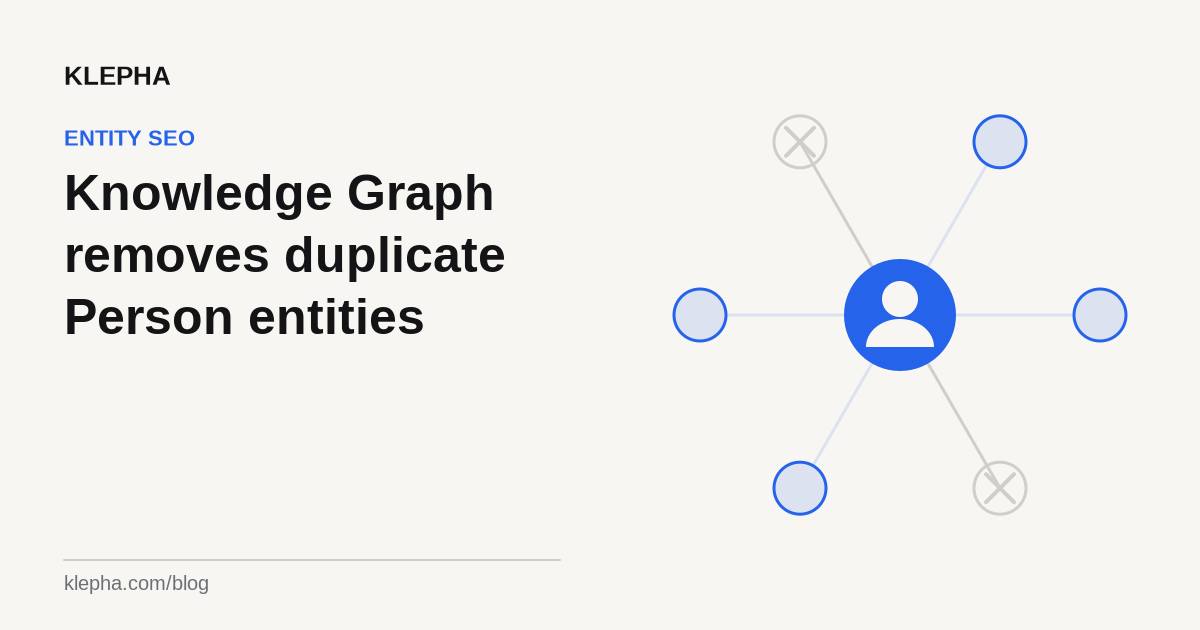
In mid November 2026, Google's Knowledge Graph dropped about 10% of the Person entities that Kalicube tracks daily, and most of the removed entries were blank duplicates: thin records with little or no data attached, sitting next to a stronger record for the same name. Search Engine Land published Jason Barnard's analysis of the update on November 20, 2026, and Kalicube's public Knowledge Graph Sensor shows the average number of entities returned per tracked name falling from 45.4 to 42.6 on November 16 before partly recovering.
Google has not announced the update, so everything below is based on third party measurement plus what Google documents about how the Knowledge Graph works. The practical lesson is simple: if Google holds more than one record for you, the thin one is now more likely to disappear, and you want every signal you control pointing at the strong one.
Key takeaways
- What changed: Person entities in Kalicube's tracked set fell by about 10.1%, mostly blank duplicates, according to Search Engine Land on November 20, 2026.
- Not announced: Google has not confirmed the update. Treat it as measured volatility, not policy.
- Who should check: founders, consultants, authors and executives whose name is part of the brand.
- How to check: query the Knowledge Graph Search API for your name and note every Person result and its ID.
- How to stay: one entity home, one consistent description, Person schema with sameAs links, and independent sources that agree.
What happened in Google's November 2026 Knowledge Graph update?
The update was spotted by Kalicube, which runs a daily tracker of Google's main Knowledge Graph. On November 20, 2026, Search Engine Land published Jason Barnard's write up, headlined as Google dropping 10% of Person entities from its Knowledge Graph overnight, mostly blank duplicates. The article describes Person entities in Kalicube's daily tracking down 10.1%.
Kalicube's public Knowledge Graph Sensor lets you see the shape of the change. It tracks a dataset of 6,000 names: 2,000 long running US baseline names plus 4,000 US mid market entrepreneurs and their companies. One of its public measures is the average number of related entities returned per tracked name. That figure read 45.4 on November 14 and 15, dropped to 42.6 on November 16, then settled at 44.2 to 44.3 between November 17 and 20.
| Date (2026) | Entities per tracked name | What it suggests |
|---|---|---|
| November 14 to 15 | 45.4 | Baseline before the change |
| November 16 | 42.6 | Sharp one day drop of about 6% |
| November 17 | 44.2 | Partial rebound |
| November 18 to 20 | 44.2 to 44.3 | New, lower plateau |
Two cautions before drawing conclusions. First, the 10% figure describes Person entities in Kalicube's tracked set, not a count of the entire Knowledge Graph, which Google describes as holding billions of facts. Second, Google has not commented. What we can say with confidence is that a measurable, sudden reduction happened and that it fell mostly on thin records.
What is a blank duplicate Person entity?
A Person entity is a node in the Knowledge Graph that represents a real individual, with an identifier, a name and, ideally, attributes such as a description, a job title, an image, an official website and links to other entities. Google's Knowledge Graph Search API returns these as schema.org typed results, each with an ID and a relevance score.
A blank duplicate is a second (or third) record for the same person that carries almost nothing: a name, perhaps a type, and no description or useful connections. Duplicates appear when Google's systems cannot confidently reconcile different mentions of a person, for example a speaker bio on a conference site, an author page on a publisher, and a company profile that each describe the person differently.
From Google's point of view, removing such records is housekeeping. A record with no facts cannot answer a question, and two records for one person create ambiguity. From your point of view, it is a reminder that Google keeps whichever version of you it understands best, and that is not always the version you would choose.
Why does this update matter for personal brands and entity SEO?
If your name is part of what people buy, your entity is an asset. A clear Person entity is what lets Google connect you to your company, your books, your talks and your expertise, and it is a prerequisite for a knowledge panel. Google's own help page states that knowledge panels are created automatically when there is enough information available on the open web.
There are three ways this update can touch you:
- You had one strong entity and some blank duplicates. The cleanup probably helps, because ambiguity drops. Check that the surviving record is the right one.
- You only had a blank or thin entity. You may have lost your only record. Nothing visible may change in search today, but you have less for Google and other systems to attach facts to.
- Your record was merged or replaced. The ID you used to track, for example in a sameAs link or a knowledge panel URL, may now point to a different record.
There is also an AI search angle. Assistants such as ChatGPT, Gemini and Perplexity describe people by synthesising many sources. We cannot see inside their systems, so we will not claim they read Google's Knowledge Graph directly. What is consistent across every engine we test is that an unambiguous, well corroborated identity is described more accurately than a fragmented one. The work that protects your Google entity is the same work that improves how assistants describe you, which is why we cover it alongside tracking your visibility in AI search.
How do you check whether your own entity survived?
You can check in about fifteen minutes. The steps below use only public tools.
- Query the Knowledge Graph Search API. Request an API key in Google Cloud, then call the entities search endpoint with your name, a limit of 10 and the type Person. Record every result that is plausibly you, with its ID (it looks like
kg:/m/...orkg:/g/...), description and resultScore. If you are not technical, several free checkers wrap this API, but the raw call is more reliable. - Compare with any IDs you saved before. If you previously noted your ID, or used it in a sameAs link or a knowledge panel share URL, check whether it still resolves to you. A missing ID is the clearest sign you were affected.
- Search Google for your name plus your role. Try "your name" plus your company, your job title and your best known work. Note whether a knowledge panel appears, and whether it is the same panel as before.
- Check the facts attached. Is the description right? Is the image yours? Is the official website your entity home? Wrong facts on the surviving record are a bigger problem than a removed duplicate.
- Log the result with a date. Entity data moves. Kalicube's sensor shows several volatility spikes in autumn 2026, including October 30 and 31 and November 5. A dated log lets you tell an update from a change you caused.
How do you strengthen your entity so you are the record that stays?
The goal is to make one record of you so clear and so well corroborated that Google has no reason to keep a competing one. These are the steps, in the order we would do them.
1. Choose one entity home
Pick one page that is the authoritative source about you: usually an about page on your personal site or a profile page on your company site. Our own author pages follow this pattern; see Garry Charter's profile for an example. Every other profile should link to it.
2. Write one description and use it everywhere
Write a two sentence description: who you are, what you do, for whom. Use the same wording, or very close to it, on your entity home, LinkedIn, speaker bios, author bios and directory listings. Inconsistent descriptions are one of the most common reasons systems fail to reconcile mentions into one person.
3. Add Person schema with sameAs links
On the entity home, add Person structured data with your name, job title, employer as an Organization, image, description and a sameAs list pointing to your genuine profiles. If you found a correct Knowledge Graph ID in step one, it can be included too. Our schema markup guide covers the syntax and the validation steps. Mark up only facts that are visible on the page.
4. Claim your knowledge panel if you have one
Google's help documentation says the subject or an official representative of an entity in a knowledge panel can claim it and suggest changes, and that facts in the Knowledge Graph also come from content owners who suggest changes to panels they have claimed. Claiming does not create a panel, but it gives you a direct feedback channel on the one you have.
5. Earn independent sources that agree
Google says Knowledge Graph facts come from a variety of public sources, licensed data and content owners. You control the last of those; the first takes work. Interviews, podcast pages, conference speaker pages, publisher author pages and industry directories that describe you consistently are the corroboration layer. Ten sources that agree are worth more than fifty that each say something different.
See how AI assistants describe you today
A free Klepha report runs real questions about you or your brand across ChatGPT, Gemini and Perplexity and stores every answer, so you can see where the description is wrong or thin.
Get my free reportWhich entity signals matter most?
Not every signal carries the same weight or the same effort. This is how we prioritise them for clients on our personal brand plan, based on what we control and how directly it feeds entity understanding.
| Signal | Who controls it | Effort | Why it matters |
|---|---|---|---|
| Entity home page | You | Low | Gives every other source one place to point to |
| Consistent description | You | Low | Helps systems reconcile mentions into one person |
| Person schema with sameAs | You | Low | States identity and links profiles in machine readable form |
| Claimed knowledge panel | You, once a panel exists | Medium | Direct channel to suggest corrections |
| Independent profiles and coverage | Third parties | High | Corroboration from sources Google treats as public evidence |
The first three can be done this week. They are also exactly what our technical SEO and schema practice audits first, because they are cheap and they compound.
What should you avoid after an entity drop?
Do not create new profiles to replace a lost record. More thin profiles with different wording can create the very ambiguity that produces blank duplicates. Strengthen the sources you have before adding new ones.
Do not buy a knowledge panel. Google states that panels are generated automatically when there is enough information on the open web and that the decision to display one is automatic. Anyone promising a guaranteed panel is promising something outside their control.
Do not overreact to one day of data. The sensor shows a sharp drop on November 16 and a partial rebound the next day. Check your own records again after a week before rebuilding anything.
Do not mark up facts that are not on the page. Structured data that contradicts visible content undermines trust in all of it. If you want to see how this approach has worked for brands we run ourselves, our case studies show the in house projects and what changed.
Sources
- Search Engine Land: Google's November Knowledge Graph update dropped 10% of Person entities, by Jason Barnard. Published November 20, 2026; headline and summary checked November 21, 2026 (full article blocked automated reading). Reports Person entities in Kalicube's daily tracking down 10.1%, mostly blank duplicates.
- Kalicube Pro: Knowledge Graph Sensor. Accessed November 21, 2026. Daily volatility and entities per tracked name for a dataset of 6,000 names; 45.4 on November 15, 42.6 on November 16, 44.3 on November 20, 2026.
- Google Knowledge Panel Help: How Google's Knowledge Graph works. Accessed November 21, 2026. Where Knowledge Graph facts come from, automatic creation of knowledge panels, claiming and feedback.
- Google for Developers: Google Knowledge Graph Search API. Accessed November 21, 2026. Entity search endpoint, schema.org types, entity IDs and resultScore.
Frequently asked questions
What did Google's November 2026 Knowledge Graph update change?
Kalicube's daily tracking recorded Person entities in its dataset dropping by about 10.1% in mid November 2026, mostly blank duplicates, as reported by Search Engine Land on November 20, 2026. Kalicube's public sensor shows average entities per tracked name falling from 45.4 to 42.6 on November 16 before settling around 44.2. Google has not announced the update.
Did Google delete 10% of all people from the Knowledge Graph?
No. The 10% figure describes Person entities in Kalicube's tracked dataset of 6,000 names, not the whole Knowledge Graph. Most removed records were thin duplicates with little or no data, so many people kept a stronger record for the same name.
How can I check if my Knowledge Graph entity was removed?
Query the Google Knowledge Graph Search API for your name with the type Person and note every result that is you, with its ID, description and score. Compare it with any ID you saved before, search Google for your name plus your role, and check whether the surviving record has the right description, image and website.
Will losing a duplicate entity hurt my knowledge panel?
Usually not. If you had one strong record and some blank duplicates, removing the duplicates reduces ambiguity. The risk is higher if your only record was thin, or if the surviving record carries wrong facts, so check which record remains and what it says.
How do I strengthen my Person entity in Google?
Choose one entity home page, write one consistent description and use it on every profile, add Person schema with sameAs links to your genuine profiles, claim your knowledge panel if one exists, and earn independent sources such as author pages, interviews and speaker pages that describe you the same way.
Can I pay to get a Google knowledge panel?
No. Google states that knowledge panels are created automatically when there is enough information available on the open web and that display decisions are automatic. You can improve the evidence about you, but nobody can guarantee a panel.