How do you choose a domain name that works for SEO and branding?
A good domain is short, easy to say and spell, distinctive enough to own as a brand, and on an extension that fits your market. Keywords help far less than most people think. Here is how to weigh length, keywords and extensions, and the checks to run before you buy.
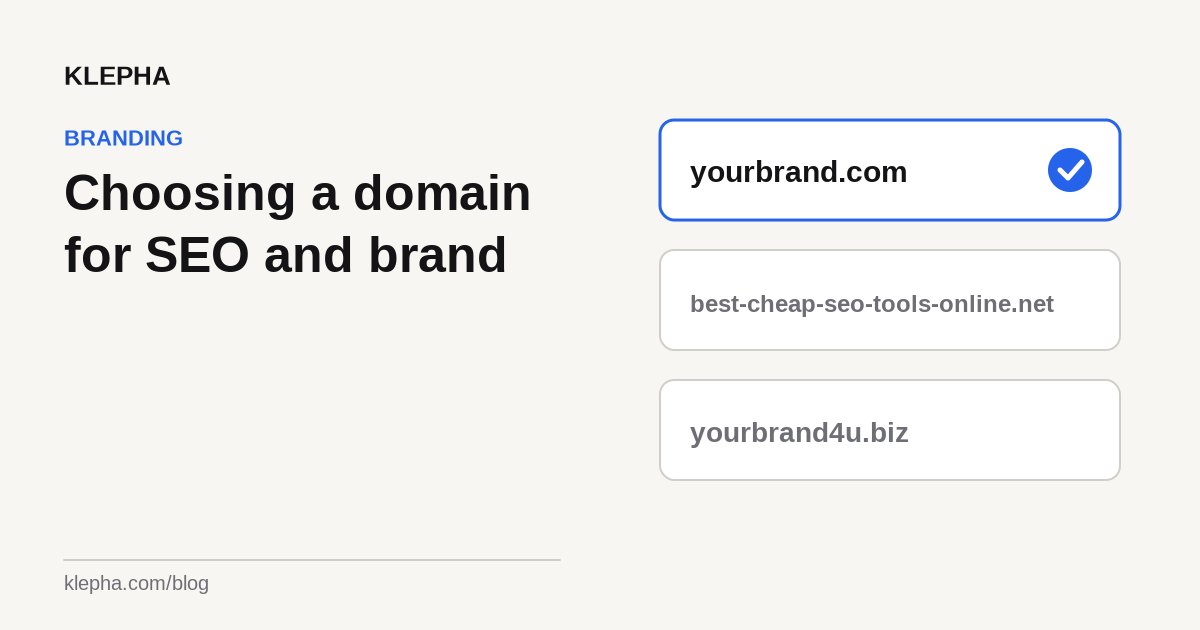
Choose a domain name that is short, easy to say and spell, distinctive enough to build a brand on, and on an extension that matches your audience, usually .com or your country's code. Keywords in the domain give little or no search advantage today, so a memorable brand name beats a keyword string.
From an SEO point of view, the domain matters most for what it signals and what it carries: a country code tells Google which country you target, and a previously used domain can carry old penalties or spam history. Check trademarks, social handles and the domain's past before buying, and pick a name you will not want to change, because moving domains causes temporary ranking fluctuation.
Key takeaways
- Brand first: a short, pronounceable, distinctive name earns more searches and links over time than a keyword string.
- Keywords are optional: use one only if it reads naturally; exact match domains carry no special advantage.
- Extension: .com for international audiences; a ccTLD such as .de or .co.uk when you target one country, because Google treats it as a strong country signal.
- Watch generic ccTLDs: Google treats .ai, .io, .co, .me and .tv as generic, not as country targeting.
- Check history: look for manual actions, leftover URL removals and spammy past content before buying any used domain.
What matters most in a domain name?
A domain name does two jobs. For people, it is the name they must remember, say, type and trust. For search engines, it is a stable address that collects links and signals over years, and sometimes a hint about which country you serve. Most domain decisions go wrong when people optimize for the second job in a way that hurts the first, for example by cramming keywords into a name nobody can remember.
We use five criteria, roughly in order of importance:
| Criterion | What good looks like | Why it matters |
|---|---|---|
| Memorable | One or two real or coined words, easy to recall after hearing once | Drives direct visits and branded searches, which grow with every mention |
| Easy to say and spell | Passes the "radio test": someone hearing it can type it correctly | Avoids lost traffic from misspellings and confused word of mouth |
| Distinctive | Not generic, not close to a competitor or an existing trademark | You can own it in search results, AI answers and legally |
| Right extension | .com or a country code that matches your market | Sets expectations for users and gives Google geotargeting signals |
| Clean history | No penalties, spam or unrelated past use | Old problems can follow a domain to its new owner |
A distinctive name also helps in AI search. Assistants such as ChatGPT and Gemini need to understand which entity you are. A unique brand name that is used consistently across your site, profiles and mentions is far easier to describe correctly than a generic phrase shared with dozens of other businesses. We cover this in more depth in increasing brand visibility across search and AI.
How long should a domain name be?
As short as you can make it while keeping it meaningful. There is no ranking rule about length, but shorter names are easier to remember, type on a phone, fit on packaging and say in a conversation. As a practical guide:
- Aim for one or two words. Three can work if it reads as a natural phrase.
- Count syllables, not just characters. A seven letter name with four awkward syllables is harder to share than a ten letter name that rolls off the tongue.
- Avoid ambiguous word joins. Read the name in lowercase without spaces. Some combinations accidentally form other words.
- Do not sacrifice clarity for brevity. A slightly longer name that people can spell beats a short one with odd letter swaps.
Should your domain include keywords?
Only if the keyword fits your brand naturally. Many years ago, exact match domains such as cheapflightstoparis.com could rank on the strength of the name alone. Google reduced that advantage long ago, and today rankings depend on content, links and many other signals rather than the words in the domain. A keyword domain still has two small benefits: it can tell people what you do at a glance, and links that use your brand name also contain the keyword. Against that:
- Keyword domains are hard to brand. "Best Cheap Plumbers London" is a description, not a name people remember or search for.
- They limit growth. A domain named after one product or city becomes awkward when you expand.
- They can look spammy. Long, hyphenated keyword strings are associated with low quality sites, which affects click through rates and trust.
- Multiple keyword domains are risky. Google's spam policies list "having multiple domain names or pages targeted at specific regions or cities that funnel users to one page" as an example of doorway abuse.
A useful middle ground is a brand word plus a short descriptor, for example a coined name followed by "law", "dental" or "studio". It reads as a name but still hints at the category.
Which domain extension should you choose?
The extension is the top level domain (TLD). Google's documentation on multi regional sites explains how it treats the main types, which is the part of the decision that actually affects search.
| Type | Examples | How Google treats it | Best for |
|---|---|---|---|
| Generic TLD | .com, .org, .net | No country signal; you can target countries with other methods such as hreflang | International or national businesses; .com is the default people assume |
| Country code TLD | .de, .fr, .co.uk, .ca | A strong signal that the site targets that country | Businesses focused on one country |
| Generic regional TLD | .eu, .asia | Treated as generic, like .com | Regional branding, without geotargeting |
| ccTLDs Google treats as generic | .ai, .io, .co, .me, .tv, .fm and others | Treated as generic, not as targeting that country | Tech and media brands that want a short, available name |
| New generic TLDs | .studio, .shop, .agency | Treated as generic TLDs, with no country signal | Brands that find a good name unavailable on .com |
Two practical notes. First, Google says some countries restrict who can register their ccTLD, so check eligibility before planning around one. Second, user expectation still matters: many people type .com by habit, so if you choose another extension, consider also registering the .com if it is available and redirecting it, to catch misdirected visitors and protect your brand.
For multi country businesses, Google compares the options as country domains (clear targeting but more cost and infrastructure), subdomains on a generic TLD, and subdirectories on a generic TLD (easiest to set up and maintain). Our guide to SEO friendly URL structure covers how to organise those folders.
See how search and AI already describe your brand
Klepha's free report shows how Google, ChatGPT, Gemini and Perplexity describe your brand today, which helps when you are naming or renaming a product.
Get my free reportWhich mistakes make a domain hard to remember or trust?
- Hyphens and numbers. People forget where the hyphen goes, and "4" versus "four" has to be explained every time you say the name.
- Creative misspellings. Dropping vowels or swapping letters makes a name available but sends word of mouth traffic to someone else.
- Names too close to a competitor or trademark. Confusion hurts both branded search and trust, and it can lead to legal disputes and a forced rebrand.
- Unusual extensions that look unreliable. Some extensions are associated with spam in many people's minds, which can lower click through rates from results and emails.
- Names that box you in. A product, city or year in the domain becomes a problem when the business changes.
- Ignoring how it looks in email. Your domain will appear in every email address. Say "name at domain" out loud and check it is not awkward or easily misheard.
What should you check before buying?
- Trademarks. Search the trademark database in each country where you operate, for example the USPTO in the United States, and consider professional advice before investing in a brand.
- Search results and AI answers for the name. Search the name in Google and ask AI assistants about it. If it is already strongly associated with another business, you will be competing with them for your own name.
- Social handles. Check that matching handles are available on the platforms you will use, so your brand is consistent everywhere.
- Domain history. For any domain that was registered before, look at archived versions of the site and its backlinks. Google's site move guide advises cleaning up a recently purchased domain by checking Search Console for manual actions from previous spam and for leftover URL removals from the previous owner, especially a site wide removal.
- Expired domain intent. Buying an expired domain with existing links to rank a new, unrelated site is a known spam tactic. Google's spam policies define expired domain abuse as repurposing an expired domain "primarily to manipulate search rankings by hosting content that provides little to no value to users", with examples such as affiliate content on a former government site.
- Renewal price and ownership. Premium names can carry high renewal fees. Register the domain in a company account you control, with auto renewal and registrar lock turned on.
Should you change an existing domain?
Only for a strong reason, such as a rebrand, a legal problem or merging several sites. Google's site move guidance says to expect temporary ranking fluctuation while Google recrawls and reindexes, that medium sized sites can take a few weeks or more for new URLs to replace old ones, and that you should keep redirects for as long as possible, generally at least a year. It also recommends changing only one thing at a time, for example moving the domain first and redesigning later.
If you do move, use one to one permanent redirects, submit a Change of Address in Search Console, and follow our website migration SEO checklist. Before renaming, it helps to be clear on what the brand stands for; our guide to writing a brand positioning statement is a good starting point.
Naming and entity consistency are part of the work behind our service for individuals and personal brands and the disciplines on our expertise page. Our case studies show how we build visibility for brands from launch.
Sources
- Google Search Central: Managing multi-regional and multilingual sites. Accessed November 22, 2026. How Google treats ccTLDs, generic regional TLDs and ccTLDs it treats as generic (including .ai, .co, .io, .me, .tv), and URL structure options for country targeting.
- Google Search Central: How to move a site. Accessed November 22, 2026. Ranking fluctuation during moves, cleaning up a recently purchased domain, Change of Address, keeping redirects at least one year.
- Google Search Central: Spam policies for Google web search. Last updated August 28, 2026; accessed November 22, 2026. Doorway abuse with multiple regional domains and expired domain abuse.
Frequently asked questions
Does a keyword in the domain name help SEO?
Very little. Rankings depend mainly on content, links and other signals, not the words in the domain. A keyword can help people understand what you do, but a memorable brand name is usually the better long term choice.
Which domain extension is best for SEO?
There is no extension that ranks better by itself. Use .com or another generic TLD for international audiences, and a country code such as .de or .co.uk if you target one country, because Google treats ccTLDs as a strong country signal.
Does Google treat .ai, .io and .co as country domains?
No. Google treats a list of ccTLDs, including .ai, .io, .co, .me and .tv, as generic domains because people use them generically, so they do not geotarget the related country.
How long should a domain name be?
As short as possible while staying meaningful, ideally one or two words that are easy to say and spell. There is no ranking rule about length, but short names are easier to remember, type and share.
Is it safe to buy an expired domain for SEO?
It is fine to buy a used domain for a genuine brand, but check its history first. Repurposing an expired domain mainly to rank unrelated low value content is expired domain abuse under Google's spam policies, and old manual actions or URL removals can carry over.
Should I change my domain name to improve SEO?
Usually not. Changing domains causes temporary ranking fluctuation and requires careful redirects kept for at least a year. Change only for a strong reason such as a rebrand, legal issue or site merger.