How do you write a FAQ section that helps both SEO and AI answers?
A FAQ section helps SEO and AI answers when it answers real questions your customers ask, in one to three direct sentences each, on the page where that question comes up. Pull the questions from sales calls, support tickets, site search and "People also ask", answer with the fact first, and keep any FAQPage markup identical to the visible text.
Most FAQ sections are written last, in ten minutes, from questions the marketing team imagines. That is why they rarely help. The FAQs that earn search traffic and show up in AI answers are built from questions buyers actually type and ask, and they answer them more plainly than the rest of the page does.
This guide covers where to find those questions, how to choose which ones belong on a page, how to write answers that a person and a language model can both lift cleanly, and what structured data can and cannot do for you. Google documentation referenced here was checked on November 18, 2026.
Key takeaways
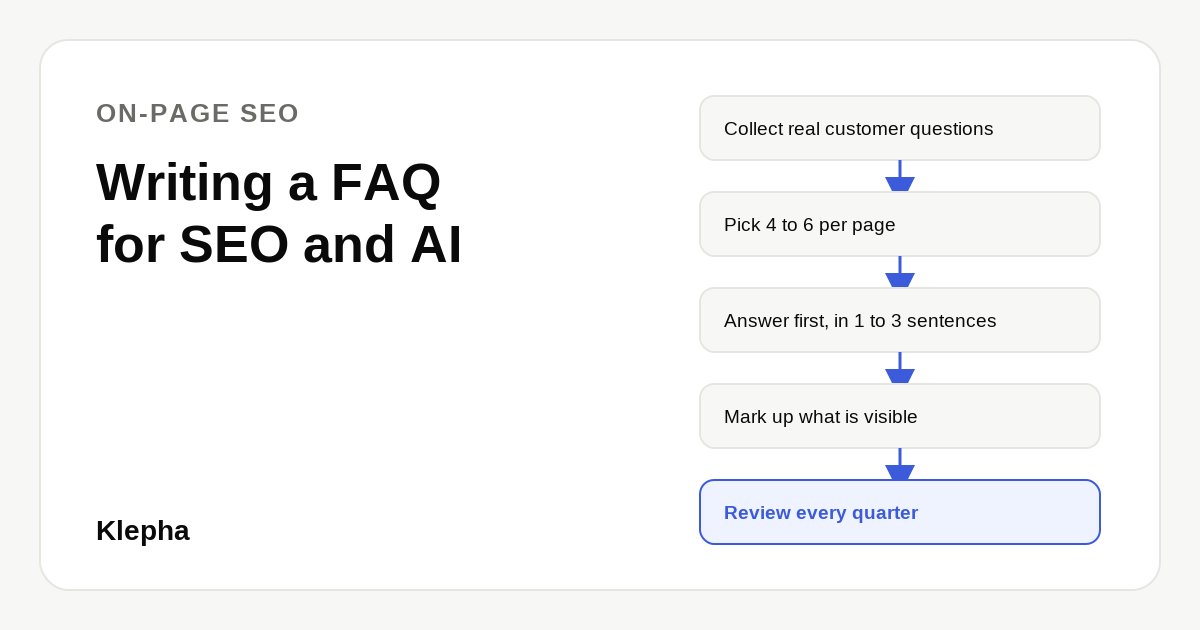
- Start from evidence, not guesses. Support tickets, sales calls, site search, reviews and "People also ask" are better question sources than a brainstorm.
- Answer first. The first sentence should be the answer itself. Context comes after, and most answers fit in 40 to 80 words.
- Four to six questions per page. Each should be specific to that page. Generic company FAQs belong on one FAQ page, not on every post.
- Schema must match the visible text. Google stopped showing FAQ rich results on May 7, 2026, so markup is for clarity and other consumers, not for expandable results.
- Treat FAQs as a living asset. Review them each quarter against new tickets, AI answers about your brand and Search Console queries.
Why does a FAQ section still matter for SEO and AI answers?
A good FAQ section does three jobs. It catches long, specific queries that the main body of a page does not target directly. It removes objections that stop a reader from converting. And it gives search engines and AI assistants short, self-contained answers they can match to a question.
That last point matters more now. Assistants such as ChatGPT, Gemini and Perplexity tend to work with passages rather than whole pages: a retrieval step finds text that answers the user's question, and the model writes its reply from it. A paragraph that states one clear answer to one clear question is easy to retrieve and easy to quote. A paragraph that circles the topic for 200 words before getting to the point is not. Our guide on how LLMs choose sources goes deeper on that retrieval step.
None of this guarantees a citation or a ranking. A FAQ answer competes with every other page that answers the same question, and authority, freshness and relevance still decide which one is used. What a well-written FAQ does is remove the reasons your page would be passed over.
Where do you find the real questions customers ask?
The best questions are already sitting in your own systems. Work through these sources and paste every question into one sheet, in the customer's words:
| Source | What to pull | Why it helps |
|---|---|---|
| Support tickets and live chat | The opening question of each conversation for the last 90 days | Shows confusion and blockers in the buyer's own language |
| Sales call notes and recordings | Objections and "how does it compare" questions | Covers the late-stage questions that decide deals |
| Site search logs | Searches with no results or a quick exit | Reveals content people expected and did not find |
| Google Search Console | Queries that start with how, what, why, can, does, is | Questions you already earn impressions for but may answer poorly |
| "People also ask" and related searches | Questions shown for your main keyword | Signals which follow-up questions Google associates with the topic |
| Reviews, Reddit and community threads | Questions people ask each other about your category | Unfiltered wording and worries you may not hear directly |
| AI assistants | Questions asked about your category, and what the answers get wrong about you | Shows gaps where a clear answer on your site could correct the record |
For Search Console, filter the Performance report by query with a regular expression such as ^(how|what|why|can|does|is|which)\b to isolate question queries, then sort by impressions. Questions with high impressions and a low click-through rate are a strong sign that your page shows up but does not answer clearly. The same technique helps when you look for keyword opportunities.
How do you choose which questions belong on a page?
Once the sheet has a few hundred rows, group duplicates and near duplicates. "Can I cancel anytime?", "How do I cancel?" and "Is there a contract?" are one theme. Then decide where each theme lives using three rules:
- If the question deserves a full page, write the page. A question with real search demand and a long answer, such as "How do you calculate break-even ROAS?", should be its own article. A two-line FAQ answer would waste it.
- If the question belongs to a page's topic, put it on that page. A pricing question goes on the pricing page. A setup question goes on the feature page. Specific beats generic.
- If the question is about the company in general, use one central FAQ page. Billing, data privacy, contact and account questions belong there, not repeated on every blog post.
Four to six questions per page is a practical range. Fewer can work on a narrow page. More than about eight usually means the page is trying to cover too many topics, or the FAQ is padding. Repeating the same block of questions across many pages adds no value for readers and creates near duplicate content, so avoid it.
Order matters too. Put the question most readers have first, usually a definition, cost or "is it right for me" question, and leave edge cases for the end.
How do you write a short, direct FAQ answer?
Write each answer so that it would still make sense if someone copied it out of the page with no surrounding context. That is how both featured snippets and AI answers tend to use text. A simple pattern works for most questions:
- Answer in the first sentence. Yes, no, a number, a definition or a recommendation. "Yes, you can cancel at any time from the billing page."
- Add the one condition that matters. "Your plan stays active until the end of the paid period."
- Point to the next step if there is one. A link to the detailed guide or the relevant setting.
Most answers fit in 40 to 80 words. Longer is fine when the question needs it, but if an answer passes 150 words, it probably wants its own section or page.
Some style rules that make answers easier to quote:
- Repeat the subject. Write "Klepha's Starter plan includes..." rather than "It includes...". A passage pulled out of context needs its own nouns.
- Use the customer's words in the question and precise terms in the answer. The question can say "get my brand into ChatGPT"; the answer can explain citations and retrieval.
- Give specific facts with sources or dates. "Prices as of November 2026" is more useful, and more trustworthy, than "affordable pricing".
- Avoid hedging filler and hype. "It depends" is fine only if you immediately say on what.
- One question, one answer. Do not bundle "How much does it cost and can I cancel?" into one item.
Which buyer questions do AI assistants answer without you?
A free Klepha report shows the questions ChatGPT, Gemini and Perplexity answer about your category, which brands they name, and where a clear answer on your site is missing.
Get my free reportWhat does a weak FAQ answer look like next to a strong one?
| Question | Weak answer | Strong answer |
|---|---|---|
| How long does SEO take? | SEO is a long-term strategy and results vary depending on many factors, so patience is key. | Usually months, not weeks. Google's own guidance on hiring an SEO says most changes need four months to a year to show their full effect. Low competition long tail pages can move sooner. |
| Do you offer a free trial? | We offer flexible options for every budget! | Yes. The trial lasts 14 days and does not need a card. You choose a plan, or nothing, before it ends. |
| Does FAQ schema still help? | Yes, schema is very important for SEO. | Not for Google rich results: Google stopped showing FAQ rich results on May 7, 2026. The markup still states your questions and answers in a machine-readable way for other search engines and tools, so keep it accurate if you use it. |
The trial row describes a fictional product, to show format only. The strong answers share a pattern: a direct claim first, a concrete detail second, no filler. They also avoid promises. Note that example answers about pricing should always be copied from your live pricing page, never written from memory.
Should you still add FAQPage schema?
FAQPage structured data marks up a list of questions with one answer each, written by the site owner. For years it could produce expandable question rich results in Google. That is over: Google's documentation changelog says the FAQ rich result "will no longer appear in Google Search starting May 7, 2026", and Google removed the FAQ rich result documentation in June 2026. Search Console's data anomalies page notes the matching drop in reported FAQ impressions from May 7.
So what is the markup for now? FAQPage is still a valid schema.org type, and it states each question and answer pair explicitly for any search engine, crawler or tool that reads structured data. It costs little to keep on pages with a genuine FAQ. What it will not do is change how your result looks in Google. If you use it, follow the rules that applied when it was supported, because they are simply good practice:
- Only mark up questions and answers that are visible on the page.
- Use FAQPage for questions with a single answer written by you. Pages where users submit answers, such as forums, fit QAPage instead.
- Do not use it for advertising, and do not mark up the same question on many pages of the site.
The value of a FAQ section now comes almost entirely from the visible text: the long tail queries it answers, the objections it removes and the passages assistants can retrieve.
The one rule worth enforcing with a script is that the schema text matches the visible text. On Klepha we validate that before every post goes live. Our schema markup guide covers the other types that pair well with a FAQ, such as Article, HowTo and BreadcrumbList.
How do FAQ answers get used in AI answers?
No assistant publishes a rule that says "FAQ sections are preferred". What is well understood is the general mechanism: when an assistant searches the web, it retrieves passages that match the question and then writes an answer from them, often with a citation. FAQ answers are naturally passage-shaped: one question, a direct answer, little noise. That gives them a structural advantage when the user's question closely matches yours.
To make that advantage count:
- Make sure the content is in the HTML. If your FAQ loads through JavaScript after a click, some crawlers may never see it. Use plain HTML, for example
<details>and<summary>, which keeps answers in the source while still collapsing visually. - Do not block the crawlers you want. Check robots.txt for the AI search crawlers you care about.
- Match how people ask assistants. Questions typed into ChatGPT are often longer and more conversational than Google queries. Include the natural phrasing as the question.
- Correct the record. If assistants repeat an outdated fact about your product, a clear, dated FAQ answer on your own site gives them a better source to retrieve.
For a wider view of what tends to get cited, see what content ranks in AI answers and our guide to getting content cited by AI. If you want help building this into a content programme, our Blog Ranking and ChatGPT Ranking solutions cover it.
Where should the FAQ go on the page and how should it look?
Place the FAQ near the end of the main content, after the core explanation and before related links. Readers who skim jump to it; readers who read the article reach it as a summary of loose ends. On product and pricing pages, a FAQ near the call to action works well because it answers last-minute objections.
For layout, an accordion built with native <details> elements is accessible and keeps the text in the HTML. Use the question as the visible summary, keep answers short, and avoid nesting links in every answer. If the page has an "On this page" list, include the FAQ in it so readers can jump there directly.
How do you measure and maintain a FAQ section?
A FAQ is never finished. Questions change when your product, prices and market change. A simple quarterly routine:
- Check Search Console for new question queries landing on the page, and for queries with impressions but low clicks.
- Read the last quarter of support tickets and add any question that came up repeatedly.
- Ask the main AI assistants the questions on your page and note whether your site is cited, and whether the answer about your brand is accurate.
- Remove or rewrite stale answers. Out of date answers do more harm than missing ones.
- Re-validate the schema after each edit so markup and visible text stay identical.
Track three numbers over time: clicks from question queries in Search Console, support tickets on topics the FAQ covers, and how often AI answers to your tracked prompts cite the page. The on-page SEO checklist is a good companion for the rest of the page, and our expertise page and case studies show how we apply the same process.
What is a quick FAQ checklist?
- Every question comes from a real source: tickets, calls, search data, reviews or assistants.
- Each question is specific to the page it sits on.
- Four to six questions, ordered by how many readers ask them.
- The first sentence of each answer is the answer.
- Each answer makes sense on its own, with the subject named.
- Facts that change, such as prices or limits, carry a date or source.
- The FAQ is plain HTML and visible without JavaScript.
- Any FAQPage markup matches the visible text word for word.
- The FAQ is reviewed every quarter.
Sources
- Google Search Central, "Latest Google Search Documentation Updates", entries for May 8, 2026 (deprecating the FAQ rich result) and June 2026 (removing its documentation), checked November 18, 2026. developers.google.com
- Google Search Console Help, "Data anomalies in Search Console", note on FAQ rich results from May 7, 2026, checked November 18, 2026. support.google.com
- Google Search Central, "Creating helpful, reliable, people-first content", checked November 18, 2026. developers.google.com
- Google Search Central, "Do you need an SEO?", for the four months to a year estimate, checked November 18, 2026. developers.google.com
- Google Search Console Help, "Performance report (Search results)", for query filters including regular expressions, checked November 18, 2026. support.google.com
Frequently asked questions
How many questions should a FAQ section have?
Four to six questions per page is a practical range. Each should be specific to that page. If you need more than about eight, the page may be covering too many topics, or some questions deserve their own pages.
How long should a FAQ answer be?
Most FAQ answers fit in 40 to 80 words. Put the answer in the first sentence, add the one condition that matters, and link to more detail if needed. If an answer passes 150 words, consider a full section or page instead.
Does FAQ schema still help SEO?
Not in Google rich results. Google stopped showing FAQ rich results on May 7, 2026 and removed the documentation in June 2026. FAQPage markup still describes questions and answers in a machine-readable way for other tools, so keep it accurate and identical to the visible text if you use it.
Where should I get FAQ questions from?
Use real sources: support tickets, sales calls, site search logs, question queries in Google Search Console, People also ask boxes, reviews and community threads, and the questions people ask AI assistants about your category.
Can a FAQ section help my brand appear in ChatGPT answers?
It can help but cannot guarantee it. Assistants that search the web retrieve short passages that match a question, and a clear, self-contained FAQ answer is easy to retrieve and quote. Authority, freshness and relevance still decide which source is used.