What does Anthropic's new rule on deceptive campaigns mean for GEO?
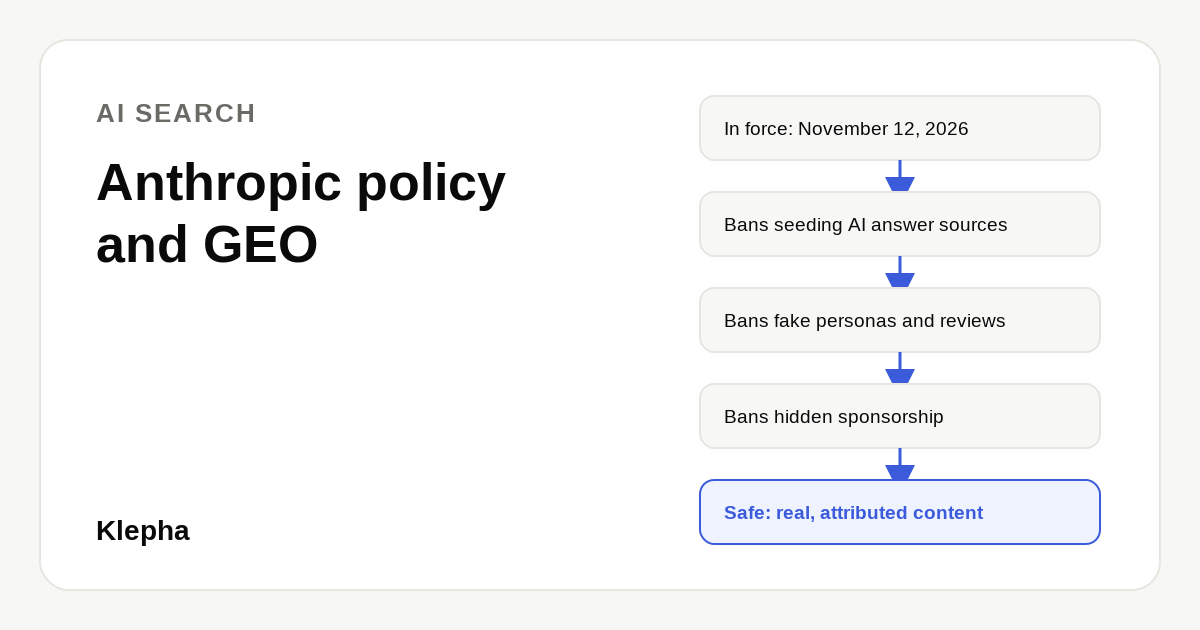
Anthropic's updated Usage Policy, in effect since November 12, 2026, prohibits using Claude to manipulate the sources search engines or AI systems draw answers from by seeding them with content that misrepresents its origin, authorship or independence. For GEO, that puts fake review networks, sockpuppet posts and sites posing as independent sources off limits for anyone using Claude, while honest work such as clear first-party pages, earned coverage and disclosed partnerships is unaffected.
Generative engine optimization (GEO) is the work of getting a brand accurately represented and cited in AI answers. Most of it overlaps with good SEO and PR. Some of it does not: there is a market for tactics that try to flood the web with "independent" voices that all say the same thing about one brand, in the hope that AI assistants will repeat it.
Anthropic's 2026 Usage Policy names that tactic directly. This post explains what the new section says, who it applies to, how it affects GEO work aimed at Claude and other assistants, and where the line falls between safe visibility work and risky shortcuts. It quotes Anthropic's policy and announcement as checked on November 18, 2026. It is not legal advice.
Key takeaways
- New section, in force November 12, 2026. Anthropic consolidated its rules into "Do Not Engage in Deceptive Campaigns or Artificial Activity", covering political and commercial deception.
- AI answer seeding is named. The policy bans using its products to "manipulate the sources from which search engines or AI systems draw answers" with content that misrepresents origin, authorship or independence.
- It governs use of Claude. The policy applies to anyone using Anthropic's products, including through the API, cloud providers and third party apps built on Claude.
- Enforcement is account level. Anthropic says it may warn, throttle, limit, suspend or terminate access.
- Honest GEO is unaffected. Clear first-party content, earned mentions, genuine reviews and disclosed sponsorships are not what the rule targets.
What changed in Anthropic's Usage Policy?
Anthropic published a new version of its Usage Policy on October 8, 2026 and said it "takes effect on November 12." Most changes clarify existing rules. The one that matters most for marketers is a new section titled Do Not Engage in Deceptive Campaigns or Artificial Activity.
In its announcement, Anthropic explained that it had seen state media, propaganda offices and "commercial firms" using Claude to run networks of fake accounts and fabricated news sites. Those uses were already prohibited, but the rules were spread across sections on elections, fraud, privacy and disinformation. The new section brings them together and, in Anthropic's words, "applies to deceptive activity of any kind (whether political or commercial)."
What exactly does the deceptive campaigns section prohibit?
The section lists six things Claude may not be used for. Quoted from the policy:
| Prohibited use (quoted) | Typical marketing example |
|---|---|
| "Create or operate fake personas, accounts, media outlets, or organizations ... in order to mislead people about their origin or attribution, how widely a view is held, or whether they are interacting with a human (e.g., sockpuppets, astroturfing, fake reviews, or bots that claim to be human)" | Writing reviews or forum posts as invented customers |
| "Misrepresent or intentionally conceal the sponsorship of content or messaging intended to influence public opinion, officials, or other decision-makers" | Paid placements dressed up as independent recommendations |
| "Distribute content through networks of fake or ostensibly independent outlets, websites, or accounts to hide that it comes from a common source" | A private network of "review" sites all run by one vendor |
| "Manipulate the sources from which search engines or AI systems draw answers by seeding them with content that misrepresents its origin, authorship, or independence (e.g., networks of sites posing as unaffiliated sources corroborating the same claims)" | Publishing many look-alike "best tools" lists to make an AI repeat one brand |
| "Build, improve, maintain, or contribute to tools, systems, or infrastructure designed to facilitate or enable deceptive campaigns" | Software that mass-creates accounts or personas for posting |
| "Market, sell, or solicit funding for any of the above as a product or service" | Selling "AI answer seeding" packages |
The fourth line is the one GEO practitioners will notice. It is unusual for a usage policy to name AI answer sources explicitly. It tells you how Anthropic sees this tactic: as a deceptive campaign, in the same family as astroturfing and fake reviews.
Other sections overlap. The disinformation section bans creating fake personas to "falsely attribute content or mislead audiences about its origin". The fraud section bans generating spam and "actions or behaviors that circumvent the guardrails or terms of other platforms or services", which matters if a tactic breaks a forum's or review site's rules.
Who does the policy apply to?
The policy states that it applies to anyone who submits inputs to Anthropic's products or services. That includes people using the Claude apps and Claude Code, developers and businesses using the API, customers using Claude through cloud providers and resellers, and end users of products that integrate Claude. A marketing tool built on Claude is covered, and so is the agency using it.
Two limits are worth being clear about:
- It is a usage policy, not a ranking rule. It governs what you may use Anthropic's products to do. It does not say how Claude chooses or ranks sources when it searches the web. Anthropic has not published anything here about penalizing sites in Claude's answers.
- It applies to Claude, not to every tool. Someone running a fake review network with other software is not violating Anthropic's policy. They may well be violating platform rules, consumer protection law and search engine spam policies instead.
On enforcement, the policy says Anthropic's Safeguards Team uses detection and monitoring, and that suspected violations can lead it to "warn you or throttle, limit, suspend, or terminate your access."
How does this change GEO tactics aimed at Claude answers?
For legitimate teams, very little changes in practice. The policy draws a line around deception about who is speaking, not around promotion itself. You can still use Claude to research, draft and improve content that is honestly published under your own name. What you cannot do with Claude is manufacture the appearance of independent agreement.
The policy also confirms what GEO practitioners have argued for a while: AI answers draw on what the web says, so the web is where the effort goes. The question is whether that effort is earned and attributed, or faked. Our guide on how LLMs choose sources explains why corroboration across independent sites carries weight, which is exactly why faking it is tempting and why it is now named.
See how AI assistants describe your brand today, without shortcuts
A free Klepha report shows which questions ChatGPT, Gemini and Perplexity answer about your category, whether they mention you, and which sources they rely on.
Get my free reportWhich GEO tactics are safe and which are risky?
| Safe visibility work | Risky shortcut | Why the shortcut is a problem |
|---|---|---|
| Clear, factual pages on your own site that answer buyer questions | Many near-identical pages on separate domains that pretend to be unrelated | Matches "networks of sites posing as unaffiliated sources" |
| Comparison pages on your own site, clearly branded as yours | "Independent" top 10 lists secretly owned or paid for by one vendor | Conceals common source and sponsorship |
| Asking real customers for honest reviews | Writing reviews as invented customers | Named directly: "fake reviews" |
| Staff joining community discussions as themselves, with disclosure | Sockpuppet accounts recommending your product on forums | Named directly: "sockpuppets, astroturfing" |
| Sponsored content labelled as sponsored | Paid posts presented as editorial opinion | Conceals sponsorship |
| Digital PR that earns coverage from real journalists | Press release networks of fake news sites | Fake media outlets |
The safe column is also what tends to work over time. Assistants and search engines both look for consistent facts from sources with their own reputations. Our guides on getting content cited by AI and appearing in ChatGPT answers cover the honest playbook in detail, and our link building guide covers earning mentions without buying them.
Reddit and other communities deserve a specific note. Participating as a brand is legitimate when you do it openly and follow each community's rules. Our Reddit Marketing solution is built around monitoring and genuine participation, not sockpuppets, and the new policy is one more reason to keep it that way.
How does this line up with Google's rules and other platforms?
Anthropic is not alone in drawing these lines, although each company uses its own definitions. Google's spam policies, which we covered in our September 2026 spam update guide, target practices such as scaled content abuse and link schemes, and Google has its own rules against AI impersonation in ads. Review platforms and forums have their own terms on fake reviews and undisclosed promotion.
A tactic that tries to fake independent consensus usually breaks several of these at once. That is a practical risk as well as an ethical one: if the tactic is discovered, the brand loses trust with the very sources AI assistants rely on.
What should brands and agencies check now?
- List every channel where your brand appears through content you created or paid for: guest posts, review programs, affiliate lists, community posts, press releases.
- Check attribution. For each item, would a reader know who wrote it and who paid for it? If not, add disclosure or remove it.
- Review vendors. If an agency or tool promises AI visibility through "seeding", ask exactly what it publishes, where, and under whose name. If it uses Claude to create undisclosed or fake-source content, the policy prohibits it.
- Audit AI tool workflows. Using Claude to draft honest, attributed content is fine. Using it to write reviews, forum posts or articles under invented identities is not.
- Invest in the safe column. Clear first-party pages, genuine reviews, earned coverage and transparent partnerships.
- Monitor what AI says about you. Track mentions and sources so you can correct errors with real content. See how to monitor AI mentions of your brand.
Klepha's own position has not changed: we do not promise guaranteed placement in AI answers, and we do not sell tactics that fake independence. For the full set of disciplines we use, see our expertise page, our ChatGPT Ranking solution and our case studies.
Sources
- Anthropic, "Usage Policy", section "Do Not Engage in Deceptive Campaigns or Artificial Activity", checked November 18, 2026. anthropic.com
- Anthropic, "2026 Usage Policy update", October 8, 2026, stating the policy takes effect on November 12. anthropic.com
- Anthropic, threat intelligence report for September 2026, linked from the policy announcement. anthropic.com
Frequently asked questions
When did Anthropic's new usage policy take effect?
Anthropic published the 2026 Usage Policy update on October 8, 2026 and said it takes effect on November 12, 2026.
Does Anthropic's policy ban GEO?
No. It bans deception, not optimization. Using Claude to research and draft honest content published under your own name is allowed. Using Claude to create fake personas, fake reviews, hidden sponsorship or networks of sites posing as independent sources is prohibited.
What does the policy say about AI answers specifically?
It prohibits using Anthropic's products to manipulate the sources from which search engines or AI systems draw answers by seeding them with content that misrepresents its origin, authorship or independence, such as networks of sites posing as unaffiliated sources corroborating the same claims.
Does the policy affect how Claude ranks my website?
The policy governs how people use Anthropic's products, not how Claude selects sources. Anthropic has not published ranking rules in this policy. It does show that Anthropic treats seeded, fake-independent content as a deceptive campaign.
What happens if someone breaks the policy?
Anthropic says that if it suspects a violation it may warn the user or throttle, limit, suspend or terminate their access to its products and services.