How do you get backlinks without buying them?
Small sites earn backlinks without paying by first publishing something worth citing, such as original data, a free tool or a definitive resource, and then putting it in front of people who already link to that kind of thing. Outreach, digital PR and resource page requests all work once that asset exists, and almost never before it.
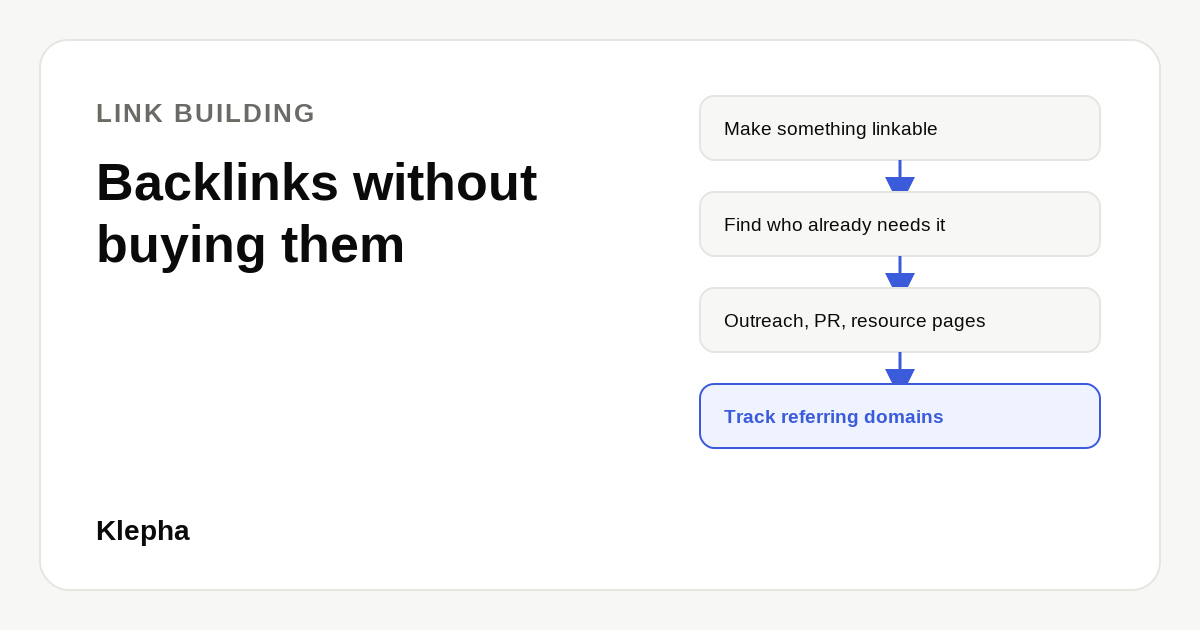
Every guide to link building assumes a starting point a small site does not have. Broken link building, resource page outreach and digital PR all presume that when someone visits your site to judge the request, they find something that makes linking seem reasonable.
At zero authority, with fifteen pages and no traffic, they often do not. That is why new sites run outreach with response rates near zero and conclude that link building only works if you pay. The real problem is running step three before step one. This guide, updated in November 2026, covers the sequence that works, the free tactics in detail and why buying links is a bad trade even before you consider the policy risk.
Key takeaways
- Make the asset before the ask. Outreach is downstream of having something linkable. Reversing that order is why most campaigns fail.
- You need fewer links than you think. For the queries a new site should target, often none at all.
- Relevance beats authority scores. A link from a small site in your exact field is worth more than a high metric general one.
- Buying links is a poor trade. Google's spam policies treat links bought to pass ranking credit as link spam, and the sites that sell them rarely have real readers.
- Resource pages and digital PR scale with effort, not money. Both reward specific, useful, well sourced work.
Why do most small sites get link building wrong?
Link building is the most expensive form of SEO, in money and in time, and it is the one most commonly attempted first.
The reasoning is understandable. Everyone knows links matter, and it feels like the thing that separates you from the sites above you. But it inverts the economics. On-page and technical work costs little, is entirely within your control and reports back within weeks. Link acquisition costs a great deal, depends on other people and reports back in months.
So the sequence that works is: fix indexation, choose winnable queries, build genuinely good pages, link them internally, then establish whether you have an authority problem at all. Most sites never reach that last step, because the cheaper work solved the problem. That progression is laid out in our step-by-step SEO guide, and our guide to internal linking for SEO covers the "link them internally" step.
You have an authority problem when, and only when, you can name specific queries where you rank between five and fifteen with a page that is genuinely better than the ones above you. Anything else is a relevance problem, and links will not fix it.
Why not just buy backlinks?
Because it is a poor trade on every axis. Google's spam policies define link spam to include buying or selling links for ranking purposes, including exchanging money, goods or services for links, or paying for posts that contain links. Google's documentation says paid and sponsored links should carry the rel="sponsored" or rel="nofollow" attribute, which means a properly marked paid link is not supposed to pass ranking credit in the first place.
The policy risk is real but secondary. The practical problem is that sites that sell links usually have no genuine audience, so the link sends no visitors and carries little weight even before anyone notices it. You are buying a number in an SEO tool rather than an outcome. The same money spent on original data, a small tool or a freelance researcher produces an asset that keeps earning links for years.
Paying for advertising, sponsorships or a booth at an event is fine. The line is paying specifically for a link meant to influence rankings without disclosing it.
Which approaches work from zero?
1. Publish data nobody else has. This is the most reliable method, and most companies are sitting on the raw material without realizing it. Whatever your product or service does, it generates observations about your industry that nobody outside can make. Aggregate it, anonymize it and publish it with a clear methodology. Journalists and bloggers need statistics to cite, and there are far fewer sources of original numbers than there are people needing them. It works at zero authority because the link is not a favor: someone needs a figure, yours is the only one that exists, and they cite it.
2. Build one small free tool. A calculator, converter, checker or generator that solves one specific annoyance in your field. Tools accumulate links continuously because people reference them in answers, forum replies and documentation for years. Most successful link earning tools are a single page doing one small thing well.
3. Take a clear position on a live debate. Every industry has questions practitioners argue about. Most published content dodges them to avoid alienating anyone, which is precisely why a well argued position gets referenced, as agreement or as the thing being disagreed with. Both link.
4. Be useful in communities. Not link dropping, which is transparent and usually removed. Answer questions properly in the places your audience already gathers, with your site as context rather than pitch. These links are often nofollow and still valuable, because the pages they sit on are retrieved heavily by AI assistants, a mechanism covered in which platforms get cited in ChatGPT.
5. Get listed where your category is catalogued. Industry directories, comparison sites, curated lists, association memberships, and the integration and partner pages of the tools you work with. Unglamorous, finite and mostly achievable in a week. Partner pages in particular are overlooked: every vendor you integrate with may have a page listing companies like yours.
6. Reclaim mentions you already have. Search for your brand name and look for places you are named without a link. Someone has already decided you are worth mentioning; asking them to link the mention has the highest conversion rate in outreach by a wide margin.
What actually earns a link?
The common factor across everything above: the page gives someone a reason to reference it that has nothing to do with helping you.
People link for three reasons. To support a claim they are making, which needs data or a definitive statement. To save their reader effort, which needs a tool or a comprehensive resource. Or to argue with something, which needs a position.
Notice what is absent. Nobody links because a page is well written, thorough or nicely designed. Excellent content earns links when it contains one of those three things, and a great deal of excellent content earns nothing because it contains none of them. Before any outreach, ask: what is on this page that someone could not get elsewhere, and what claim does it let them make? If there is no answer, fix the page first. A clear content brief that names the page's original value is the easiest way to build that in from the start.
How do you write outreach that gets replies?
Once you have the asset, outreach becomes a matter of finding people who have already shown they want it. The highest yield targets, in order:
- People who linked to a worse version. Find who cites the outdated study or abandoned tool your work replaces. They have already made the editorial decision; you are offering an upgrade.
- People who mentioned you without a link. The highest conversion rate available.
- People writing about the exact subject now. Recency matters: an article published this week is still being edited; one from three years ago is not.
- People whose article has an obvious gap your data fills, where you can point at the specific paragraph.
The message matters less than the targeting, but three things reliably help: be specific about which page and which paragraph, state the value in one sentence without adjectives, and ask for nothing beyond consideration. Templates that open with praise for an "insightful article" are filtered before they are read.
Expect single digit percentage responses even when everything is right. Fifty well targeted emails producing four links is a good campaign, and four relevant links is meaningful movement for a new site.
How does resource page link building work?
A resource page is a page that exists to list useful links on a topic: a library guide, a professional association's tools list, a local council's business support page, a teacher's reading list. The owner's whole purpose is to link out to good material, which makes these pages unusually receptive to a polite, relevant suggestion.
- Find candidate pages with search operators. Combine your topic with words that resource pages use.
- Qualify each page. Is it maintained (recent updates, working links)? Is it about your exact topic? Would your page be one of the best items on it?
- Find the right contact. Usually the page author or site editor, not a general inbox.
- Send a short, specific note. Name the page, the section your resource fits, and one sentence on what it adds. If you spot a broken link on the page, mention it; that is genuinely helpful.
- Follow up once, then stop.
| Search query pattern | What it finds |
|---|---|
[topic] intitle:resources | Pages titled as resource lists |
[topic] inurl:links | Older "useful links" pages |
[topic] "useful resources" or "recommended tools" | Curated lists inside articles |
[topic] site:.edu or site:.gov plus "resources" | Academic and public sector guides (be realistic about fit) |
[your city] "small business resources" | Local business support pages, good for local companies |
Resource page outreach only works for pages that are genuinely resources: guides, tools, checklists, datasets. A product page or a sales landing page almost never belongs on these lists.
How does digital PR work for a small site?
Digital PR means earning coverage, and the links that come with it, from journalists, newsletters and industry publications. Large brands do it with agencies and big campaigns. A small site can do a focused version with three ingredients.
- A story with a number in it. Original data is the strongest hook: a survey of your customers, an analysis of your own anonymized usage data, or a price or trend tracker you update every quarter. Publish the method, the sample size and the dates, so a journalist can trust it.
- The right, small audience. Trade publications, local news and niche newsletters cover small companies far more often than national media. A local angle ("what small businesses in our city pay for X") often gets picked up.
- Expert commentary. Journalists regularly look for quotes from practitioners. Answering relevant requests quickly, with a specific and quotable opinion, earns mentions over time. Several services connect journalists with sources; check each one's current terms and fees before relying on it.
Pitch the story, not the link. Coverage that names your company without a link is still worth having for brand searches and for how AI assistants describe you, and you can politely ask for a link to the data source afterwards.
Do you have an authority problem at all?
Klepha shows which queries you rank 5 to 15 for, how far behind the incumbents you are, and whether AI assistants already name you, often before your links do anything.
Run a free visibility reportIf you plan to announce news, write the release for journalists rather than for links. Our guide on how to write a press release that earns coverage covers angles, structure and distribution.
Which tactic should you start with?
| Tactic | Needs first | Effort | Typical result for a small site |
|---|---|---|---|
| Unlinked mention reclamation | Some existing brand mentions | Low | A few quick, relevant links |
| Partner, directory and association listings | Real partners or memberships | Low | Finite set of relevant links |
| Resource page outreach | A genuinely useful guide or tool | Medium | Steady trickle of relevant links |
| Community participation | Time and real expertise | Medium, ongoing | Mostly nofollow links, strong AI visibility |
| Original data and digital PR | Data and a clear method | High | Fewer, higher value links and coverage |
| Free tool | Development time | High upfront, low ongoing | Links that keep accumulating for years |
A sensible order for most small sites: reclaim mentions and claim listings in the first week, build one linkable asset in the first month, then run resource page outreach and small PR pitches around it.
Which tactics waste the budget?
Paid links and private blog networks. Covered above: a policy risk, and links from sites with no real audience. Networks of sites posing as independent sources are also now named in Anthropic's usage policy on deceptive campaigns.
Mass guest posting. Writing something substantive for a publication with real readers remains worthwhile. The failure mode is sites that exist only to host guest posts, which have no readership and whose pattern is easy to identify. The test: would you still want this placement if the link were nofollow? If not, it is not worth the fee.
Directory submission at volume. A handful of genuine industry directories, yes. Hundreds of general purpose ones, no.
A useful rule across all three: if a method scales cheaply, it probably does not work. Methods that resist scaling, such as original data, real tools and genuine relationships, keep working because they cannot be commoditized.
How do you tell whether it is working?
Not by counting links. Count referring domains, which is the number that matters: fifty links from one site is roughly one site's worth of signal.
Then watch the metric that indicates progress: whether pages that were stuck outside the top ten begin moving. Authority is an input that unlocks positions relevance alone could not reach. If referring domains are rising and stuck pages are not moving, the links are probably irrelevant to those queries. A competitor analysis shows the gap in referring domains for the queries you care about, which turns an open ended task into a finite one.
Record where every link came from and what prompted it; after twenty links the pattern usually shows which tactic works in your field. Check quarterly for lost links, because a link reclaimed with a short email is cheaper than one earned from scratch.
Finally, AI assistants choose sources by passage relevance and freshness as well as reputation. For a new site that is good news: being precise and current can compete with being established, months before link numbers catch up, and new answer engines such as Yahoo Scout say they put source links up front. Our Blog Ranking solution, our expertise page and our case studies show how we approach this.
Sources
- Google Search Central, "Spam policies for Google web search", link spam section. developers.google.com
- Google Search Central, "Qualify your outbound links to Google" (rel="sponsored", rel="nofollow", rel="ugc"). developers.google.com
- Google Search Central, "SEO Starter Guide". developers.google.com
- Google Search Central, "Creating helpful, reliable, people-first content". developers.google.com
Frequently asked questions
How do I get backlinks for a brand new website?
Start by creating something with an independent reason to be referenced, such as original data, a free tool or a reference resource that does not exist elsewhere. Then approach people who have already linked to weaker versions of the same thing. Outreach without a linkable asset fails at almost any volume.
Should I buy backlinks?
No. Google treats links bought to pass ranking credit as link spam, and paid links are supposed to carry rel="sponsored" or rel="nofollow". Sites that sell links also rarely have a real audience, so the money works better spent on something worth citing.
What is resource page link building?
It means finding pages that exist to list useful links on a topic, such as association tool lists or local business support pages, and suggesting your genuinely useful guide or tool to the page owner. It works best for resources, not product pages.
How many backlinks does a new site need?
There is no threshold. For long tail queries, a well built page on a technically sound site often ranks with none. For competitive terms, what matters is closing the gap to the sites currently ranking, which you can measure rather than guess.
Do guest posts still work for link building?
Genuine ones do: substantive articles for publications with real readers, where the link is incidental. Sites that exist only to host guest posts do not. A useful test is whether you would still want the placement if the link were nofollow.
How long does link building take to affect rankings?
Individual links can take weeks to be discovered and evaluated, and their effect on a competitive term is usually visible only in aggregate after several months. That is why link building should follow on-page and technical work, which reports back faster.